Press articles and reviews
"(...) There is a generosity in Ralf Altrieth's painting that has its own language, vivid and colourful, without making colour a creed, humorous without being caricatural, joyful without idealism, energetic without being thunderous, in short, a deeply human language."
— Bernard Pignero, writer
"(...) His writing through gesture and colour describes a world open to new voices and to experiences never attempted. His canvases and works on paper demonstrate that painting remains a major expression of the contemporary scene."
Interview with Laurent Puech, historian and curator at the Château d'Assas >>Read the article
Louis Doucet, collector, art critic and independent curator >> Read the article
Interview with Marie de Grossouvre, Théo de Seine gallery, Paris >> Read the article
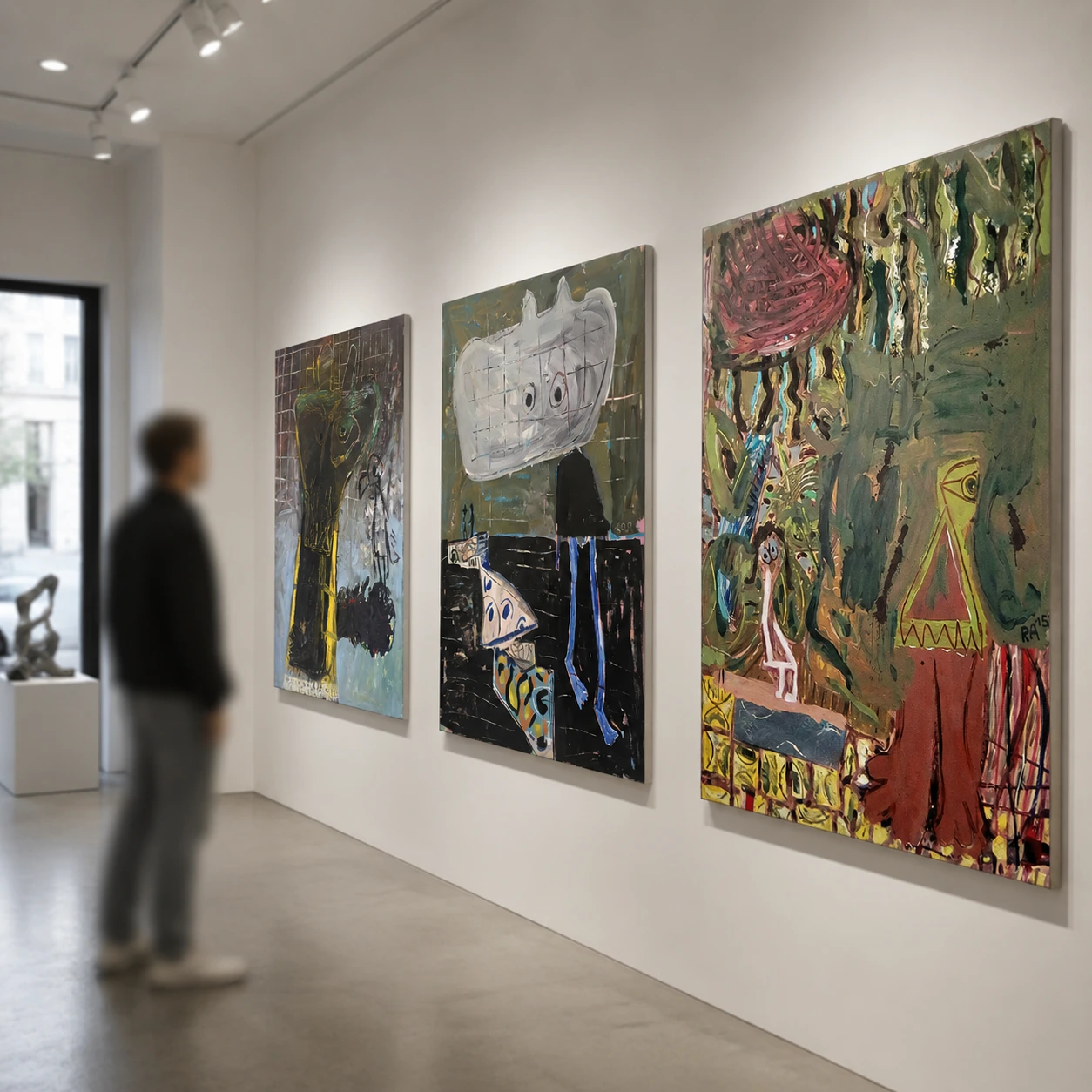
Pictorial Poems, Dr. Friedhelm Häring, art historian and museum director
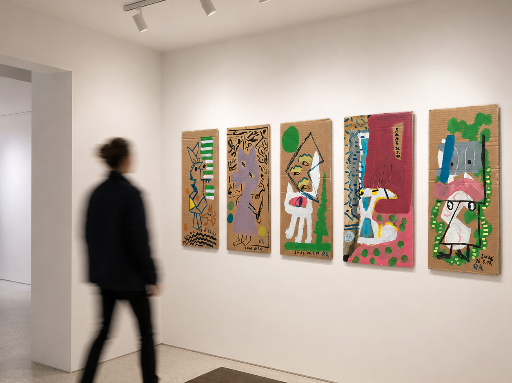
Laurent Puech, art historian and curator at the Château d'Assas, assists with the visit.
The Château d’Assas is proud to present to the public a monographic exhibition dedicated to the painter Ralf Altrieth. Imprinted with an insolent vitality, mixing rhythms directly within the pictorial material through transparency and layering, his canvases reconnect with manifestations of contemporary painting that have not been produced here in recent years.
Debates about painting are lively in France, where the latest avant-gardes of the twentieth century have turned their backs on the canvas. However, such a break with the system of representation and its pictorial procedures is not irreversible. Many great French painters such as Pierre Soulages (born in 1919), Martial Raysse (born in 1936), or Noël Dolla (born in 1945) continue to have uninterrupted activity on the international scene, unlike their predecessors from the early twentieth century, who no longer lead the way. Americans, Germans, and more generally the Anglo-Saxon sphere dominate today's pictorial creation with famous artists such as David Hockney (born in 1937), Gerhard Richter (born in 1932), Marlène Dumas (born in 1953), or Mark Bradford (born in 1961), who continually reassess it.
In 2015, the 56th Venice Biennale highlighted the expressive violence of painting with the striking shortcut of giant self-portraits by Georg Baselitz (born in 1938) to the canvases deployed in the space of Katharina Grosse (born in 1961), who sprays colour onto tarpaulins several metres high. The gesture and materiality of painting are rethought by these two artists with a decidedly contemporary expressionist vehemence.
Ralf Altrieth (born in 1966) is part of the vein of the new German expressionism without belonging to a specific school; at most, he has, like in music, received the basics of training from prestigious initiators without going further in perfecting a simple aesthetic vocabulary. This painter and saxophonist does not seek a definitive formula but the constantly renewed invention of emotional and expressive affinities.
Originally from a land as fertile as it is contested, a fraternal host country of the Huguenot Refuge, where many traits have settled over the centuries from the wine-growing slopes of the Neckar to the financial capital of Germany, Frankfurt, Ralf Altrieth keeps his distance from hismotherlandwithout having resolutely become French. Undoubtedly, he thus maintains his independence of spirit and his freedom to act as a plastician by staying away from issues, particularly aesthetic ones, limited to the national framework. Like in jazz improvisation, the superpositions and erasures that open or close the space create a dynamic for each of his pieces. The inscription of ideograms, the elementalisation of graffiti, the recurring traits of the human and animal figure construct a scriptural superstructure where the world as he sees it is hinted atfrom within.Against the aesthetic purity and moral truths of the art of the past, one can see, from the outside,the perfect worldthat he has promised us.
Focused on the density of the moment and maintaining its spontaneity, Ralf Altrieth is committed to producing works devoid of theatricality. Similar to a sportsman or a musician, his performative act does not allow for any delay in its narration, as the heterogeneity of the pictorial surface of his works testifies. The influence of Pablo Picasso (1881-1973), Jean Dubuffet (1901-1985), or Jean Michel Basquiat (1960-1988) does not close off a vision built on renewal. The very pronounced plastic expressions that one could almost qualify asaudible, especially in relation to a jazz musician like Ralf Altrieth, all carry an essential part of rebellion. Strongly marked by childhood, traversed by the ailments of the adolescent soul and the healing of manhood, the fierce singularity of this young painter delivers a universal character that he knows how to share, as this presentation, exceptional in its density, attests to,
Laurent Puech,
curator of the exhibition
* of the group Support(s)/Surface(s)
** notably in the studio of Georg Schaible (1907-2007), a German painter and engraver representing "expressive realism"
*** Ralf Altrieth has lived and worked in France since 2006
Laurent Puech, art historian and curator at the Château d'Assas, interview with Ralf Altrieth
"The perfect world", in a way the title you have chosen for this exhibition places you very precisely in your relationship with others and with society. It makes an observation not devoid of a certain irony while evoking a future construction discovered through your artistic expression. In any case, this phrase can be understood in two different ways, either it is a project in progress, or a present reality, could you clarify your position?
Yes, there is irony, but not only. I also see this title as a challenge, a manual, a belief, a game, an assertion, a provocation addressed to the present reality.
Something perfect is without flaw. But a perceived flaw is always relative, subjective, seen from a certain angle. There is no absolute truth about what is a flaw or not. This theory is, of course, extreme but, pushing the reflection further, one could say that, in the absolute, an apparent flaw is not one. Therefore, the world is perfect.
My painting works a bit like that. I try to cultivate the art of remaining attentive to the accidents and mistakes (flaws, failures, oversights, disturbing details,...) that can occur during the working process, and which are often very promising.
I admit that there are things that happen, unintended at first, in the act of making, that are strong, large, important and that are part of my painting, just like the intended things (impulses, ideas, constructions, etc.), and with which I have to work.
Thus, I do not question my means, my abilities, my know-how. I accept everything that is given to me, and this opens up surprising perspectives.
We have exchanged several times about the history of art regarding the influences that consciously or unconsciously permeate your creation. They are numerous, sincerely cherished and none is dominant, however it seemed to me that because of your profile as a musician and visual artist, you particularly retained the figure of A. R. Penck (1939-2017), an artist who was sidelined and persecuted for many years in the GDR and then, later on, achieved international success after moving to the West in 1980. In relation to the German neo-expressionist painters to whom he is linked, he is the one who models a universe of extra-European graphic signs such as calligraphy and outside the usual framework of 'historical' painting like graffiti; does his uniqueness and refusal to belong to any nationalism resonate with you?
Of course, it is the uniqueness that defines a great artist. It is what adds something new. It can simply be something unique, singular. There is no need to completely revolutionise painting.
And it seems quite logical to me that uniqueness does not sit well with the idea of belonging to a nationalism, to any group. It is clear that groups of artist painters (Dada, Surrealism, Cobra, Expressionism,...) never functioned well, at least not for long. All those artists who belonged to such groups were more or less singular artists, who tried, felt the need to come together in groups. But that is not possible. It is actually their works that bring them closer, that gather them, because one finds modes of expression that echo each other, that resemble each other like the members of the same family.
This is the case with Penck, whom I adore, but without ever looking at him too closely (to love is also to keep a bit of distance.) In any case, his work is extraordinary, absolutely singular, he is unclassifiable and, at the same time, he is placed in the family of neo-expressionists, precisely Germans. Perhaps we should not take this too seriously. Indeed, who exactly are the German neo-expressionists? In number, there are not many.
But, to speak more concretely about his painting, there is a pictorial aspect in Penck that fascinates me a lot: he is capable of making large canvases, very large canvases in one gesture and in a single layer; he does not put on a second layer, nor a third, etc. There are no qualities of textures, and it is never bothersome, it works, and perhaps that is where we find the musician: it vibrates, it dances, it sounds.
Curiously for me, you are also attached to the painting of Gérard Garouste (born in 1946) which, to say the least, is saturated with references to the old masters like Tintoretto, to biblical spirituality, and even to the mystical revelation of the Talmud! His artistic journey, including the decisive influence of Jean Dubuffet (1901-1985), would it connect you more to him than his expression itself?
First a remark: In our conversation, when we talked about Garouste, I was thinking of El Greco. I don't know why I said Tintoretto. Perhaps we should put the name El Greco here instead of Tintoretto. I find that there are really common points in their paintings. ("Vision of Saint John" or "The Laocoön" for example)
It is always the very expression that connects me to an artist. In a museum, in an exhibition, I absorb the work, I do not read the explanatory texts (later, perhaps, at home). It's like going to the cinema, the theatre, or a concert. I dive into it. I want to be with the painting. It is made for that. Gérard Garouste ends a paragraph in an interview by saying: "And yet, you know, a painting has nothing to say, it simply is."
I completely agree with that. Painting simply is, and I am simply with it. And I can be very well with the painting of Gérard Garouste. Just with his paintings, I do not need to be interested in the context, the sources, the ideas. This is something he confirms himself.
Yes, I love his painting. Especially his 1980s period, which is so rich, so singular, there is classic alongside raw art and also abstract art, it is fascinating. It is a painting that nourishes me.
I did not know that Jean Dubuffet had a great influence on him. But, in the end, it does not surprise me. I like the painting of both. And I like the painting of El Greco.
But to mention Garouste is also to refer to the passage of severe psychological depression in an artist's life; your own expression sometimes borders on this point of imbalance and suggests that you are not indifferent to this question of psychic representation, which was notably claimed by Jackson Pollock, who spoke of his paintings as "inner walls".
It is simply impossible to make art in a state of balance. Otherwise, you do not make it. If not, it is craftsmanship, illustration, decoration, or something else. You may feel the need to balance something. But in any case, you do not succeed. Not for long, anyway. It cannot therefore be a therapy either. You do not heal there. Imbalance is not necessarily a disease. That is the fate of a painter. There is nothing to be done about it; you have to deal with it.
So yes, psychic elements are fundamental. But for me, it is not about representing the psychic. Moreover, I do not like the word "representation" in general in painting. I find that all painting is, at its core, abstract, even an apple in a still life.
This brings us back to what I mentioned earlier: that painting "says nothing, it simply is."
So yes, psychic states are part of my painting, but they are not represented there.
And mustn't one also be a little unbalanced to want to paint an apple?
As both a jazz musician and a painter, you switch from one discipline to another depending on the moment, which means there is never any repetition in your work; you are constantly inventing with a taste for the present moment. Does this also mean that you claim a lightness of being instead of moving towards that sometimes heavy depth that attaches to artists who see themselves as spiritual guides?
It is madness to want to do both, and I have tried several times in my life to stop doing one or the other. At the same time, the idea of not sticking to just one of these disciplines has always appealed to me. Precisely, to perhaps remain lighter, freer.
In any case, what is essential is to ensure that you always maintain some distance, some perspective, and for a painter, that seems to me to be the most essential and obvious thing. It is in the nature of painting itself, of any kind of painting: whether you paint abstract, landscapes, still lifes, figurative, expressive or otherwise, distance is innate in the act of painting and, of course, also in the act of perceiving painting.
But I must add that, in recent years, I have been very focused on painting. Music has taken a bit of a back seat, but it is once again starting to reclaim its place in my life.
Bernard Pignero, writer
The pictorial world of Ralf Altrieth – for he also has a musical world – is of undeniable coherence. This can be verified by confronting a large number of works, of various formats and dated over several successive years. The evidence then becomes clear: what appears in an isolated painting as stemming from a fanciful imagination is merely an element, a kind of freeze-frame, extracted from an imaginary world of abundant richness but of evident continuity. Does this world pre-exist its revelation in Altrieth's work, or is it a construction that the artist elaborates as he progresses in his creative process? In other words, is the artist the mediator or the creator of what he presents to us? It is often in this alternative that what one might call creative subjectivity is hidden: does the artist speak to us of his inner world, or of one that we do not see even though it is ours? Does he stage himself, or is it us that he is interested in? It would be vain, or at least insufficient, to seek the answer in the profusion of an already considerable body of work, although this abundance is nonetheless an important clue. Similarly, the mastery with which Ralf Altrieth plays with formats, ranging from the smallest to the largest without loss of narrative intensity – and one might even suppose that monumental works would be within his reach if he had the opportunity to produce them – is an element that should not be overlooked. But we know that artistic productions limited in number, constrained in their subject or format can assert themselves as essential. It is regrettable that we are left with only a dozen paintings by Vermeer, but that is enough to know that they stem from a vision of the world that is as original as it is essential.
It is tempting to stick to the idea that there is only one reality: the one we see and which we assume everyone perceives in the same way. We may concede that each person can give a slightly different interpretation since it is clear that the calibration of our senses is not perfectly standardised. However, painters have a commendable tendency to question this reassuring certainty. Ralf Altrieth is one of those who do not seek resemblance to reality but its necessity. An artist who today would strive to copy what he sees and thus prove to us that we are indeed seeing the same thing would only be an ally of our natural conformism. Although one might legitimately consider still life as one of the peaks of art, it is on the condition that nature is not, in fact, dead there. That is another debate.
The work of Ralf Altrieth suddenly confronts you with a different reality, which may not claim originality today, but a reality that asserts itself as relevant, which is much rarer. If we accept that there is indeed only one reality, the necessity of the real, what makes it compatible with our immediate perception of the world is not a spontaneously accessible fact. The artist's approach, his mission or sometimes his curse, is to provide us with tangible evidence of this. Clearly, if Altrieth's work is indeed an artistic approach and not a pleasant mystification, it owes not only to its coherence and formal mastery but to something more that both imposes itself and eludes at the same time. It is this dual capacity to reveal without stating that generally measures the strength of art. In Ralf Altrieth's painting, there is a generosity that is neither militant nor didactic. It does not denounce, it does not judge the world as it presents it in the bias of a wonderful diversion of the obvious; it simply describes it with its own language, illustrated without being deliberately dreamlike, coloured with total ease but without making colour a profession of faith, amusing without wanting to be caricatural, joyful without idealism, energetic without being thunderous, in short, a profoundly human language.
Many young artists feel the need to work in series, thus wishing to express through a sequence of complementary artistic proposals what a single work could not concentrate. Ralf Altrieth demonstrates a maturity or a more assertive strength in that while he excels at juxtaposing series of small paintings, the accumulation of which is obviously jubilant, it is surprising to find that each of them can stand alone in its own necessity. One senses in this painting full of life and movement, not only in the large formats, a wonder of being, an openness to all the potentialities of life, a constant questioning in the face of the mysteries of humanity. There is a desire to resolutely yet joyfully seek out beauty in its final strongholds. No complacency but no dramatization in this healthy, vigorous painting, sensitive more than sensual.
As for the question of whether the artist is the mediator or the inventor of the world he presents, we are not in a position to answer for him, but it is important to us that this world is accessible and makes us want to explore it further. Ralf Altrieth invites us to do so with total generosity. Is this not what primarily authenticates an artist's signature?
Stéphane CERRI, cultural journalist
Even if it is a bit reductive, for half a century, there has always been a distrust of painting from the French avant-gardes, and often even murderous impulses. An attitude that has never existed among contemporary artists across the Rhine... Essentially BMPT and Supports/Surfaces versus Polke, Richter, Kippenberger and Baselitz... The death of the painting against the permanent flattening...
In this great hubbub, the space "must be open", because in "good painting, there is work to be done by the viewer, otherwise it is very boring". In a play of depth, layering, with an alternation of shapes that converge inward or extend outward, Ralf Altrieth mixes genres, images, styles, making them clash. "Like in life where we are just particles". In the large-format free canvases, the eye must bounce, cling, detach; it is captured by colour, by the energy of the gesture, the strange cohabitations, the musical rhythms of jazz where Ralf Altrieth also performs as a saxophonist, an enthusiast of improvisation.
Louis Doucet, collector, art critic, independent exhibition curator member of C|E|A
For several years, Ralf Altrieth has been painting episodes drawn from an imaginary and whimsical world that he seems to have created from scratch. But, upon closer inspection, one wonders whether these are reflections of an inner mode or a reinterpretation of an external reality? The question remains open… What is certain is that his works aim to be narrative, telling stories, sad or amusing, but always offbeat, even disturbing or provocative… They respond to this principle ofinner necessity, claimed by Kandinsky who wrote: "Anyone who is not touched by the inner resonance of form (both corporeal and especially abstract) will always consider such a composition as perfectly arbitrary."
The paintings of Ralf Altrieth challenge our certainties. It is, indeed, a question of reality, but of a reality that transcends the often deceptive appearances of our physical world. As if the artist were endowed with an X-ray vision that allows him to probe beneath the surface of things to focus on their essence. This is why he avoids the pitfall of caricature, even when he aims to be funny or critical. It is a work of diversion – or rather of re-centering – of perceptual certainties in favour of the vision of a third eye that would probe the depths of our humanity.
Interview with Marie de Grossouvre, at the Théo de Seine gallery, Paris
Do you feel that there has been a significant evolution in your work since 2010 (the date of the first paintings you left at the gallery)?
The first paintings I exhibited at the Théo de Seine gallery are very important in my work. What was new was mainly the principle of layering. With this, I managed to create a more precise painting. More precise in the sense that I find it more in line with my way of seeing things. I opened a door. And I found a way of painting that truly suited me and allowed me to push the painting further.
Until today, there hasn't really been any change, but of course there has been an evolution, perhaps not very large, but important. My work was very settled two or three years ago. The process was quite slow. Today, it includes very impulsive moments. There was already some radicality back then, in the sense that my canvases underwent very significant changes during the process. Today, it's the same, but there are variable phases in tempo, different in atmosphere. Moreover, I seek to go further with colour, painting itself, and texture. I really want to give the painting complete freedom. I don't want to confine it in a cage. It doesn't owe me anything.
That's how it seems to me, but is it a voluntary evolution, a desire to develop your work in one direction or another?
It's a need and at the same time a will, because one must observe oneself a bit. And I don't really want to reproduce myself, to make variations. Each canvas is a new adventure and I don't know where it will take me. But above all, I try to be as attentive as possible. Painting teaches me, and this reflection automatically generates new directions.
I have noted that you refused formal teaching to learn in a more self-taught way, but as a result:
Do you align more with a vision of 'raw art', with the idea of 'stifling culture' as Dubuffet says, or are there artists whose work you look at a lot and who inspire you?
A main driving force in my life, in my art, is freedom, the need to be free. I felt freer outside of an educational institution. And if we look closely at most artists who have managed to create something personal and innovative, it often translated into a break with their education. I perhaps did not want to wait for that.
But it’s true, I feel close to the raw art movement, especially with people like Chaissac, whom I really discovered not very long ago.
I’m not really against art schools, but I find that they sometimes produce less positive aspects for art, such as the way of thinking about a career, the attachment to positions, by selecting we value some, not at all others, etc. We put everything into boxes, etc.
As for myself, I wouldn’t really want to teach. The most important things are to be learned by observing life and, of course, also other artists.
For example, Basquiat, if I try to compare your work to his, I see common points, in the way of attaching to the surface of the canvas, in the search for a 'colourful harmony' (even if it is not conventional), for him too, the experience of the moment when he was painting must have been important...
But his story is different from yours, and in your case, one of the differences is also in the themes, there are more references to the world of childhood, to humour, even if in form there is something quite violent. What do you think?
There are certainly commonalities between my work and Basquiat's. I have also learned something important from his painting, as well as from the painting of some other artists with whom I feel a connection: it is radicality. I try to push painting further. Painting is something greater than myself. Radicality allows one to go further, to detach, to see more. I find that today, by painting canvases, I am creating myself. It has nothing to do with whether I like the painting or not. It is more a question of accuracy. And here, I return to your question. The subjects introduce themselves. Basquiat received a book on anatomy when he was young - I believe he was in hospital at that time. My subjects come from elsewhere. And I do not live in New York and I do not want to consume hard drugs. I find life itself beautiful, even though it is true that there are terrible things in this world. But that has nothing to do with life. I cannot leave dark things in my canvases (even if I sometimes succeed very well, but I do not want to leave it like that.)
And yes, childhood and humour are very close to freedom. As a child, one does not calculate, one simply is. That is freedom, even if one has to learn certain things. And humour is the perfect way to maintain distance, to create a distance. I feel that if one manages to distance oneself more and more, one ultimately approaches oneself more than ever.
Moreover, I think there is something Dada in your work, both in the way you add text to the paintings (let's say that the Dadaists were the first to do this a lot) and in this desire not to let the viewer contemplate in peace, but to create a painting that is all movement, in chaos, sometimes violent (like our society) which forces them to react. Is this a kinship you recognise or not?
I recognise a kinship there, but I must admit that I wasn't very aware of it. Dadaism made a strong impression on me when I was young, especially with Kurt Schwitters and Max Ernst. Again: movement and violence are very important parameters for painting. They allow for precision, even if the appearance suggests otherwise.
Otherwise, in 2010, there were only 'untitled' works. Now, is the title an actor?
Today, I find that a canvas deserves a title. Moreover, it is technically much simpler to manage files, images, to communicate, etc. But the title is not really an actor; it imposes itself as a form, like a colour. It is something that is added to the canvas at the end, sometimes even a little before, sometimes it needs to be corrected, a bit like a colour that is too bright or too dull, etc. Sometimes, it is necessary to integrate it directly into the painting, not always, not too often. After all, it explains nothing. It is like something poetic in addition (and here, I think we connect with Max Ernst or others). And in that sense, perhaps it becomes an actor.
There is also undoubtedly the format that changes your research?? (I realise this in the 3 columns I have made)…
Again at the fine arts in Nürtingen, I was 21 years old, I started very early with large formats. I immediately loved the canvases that impose themselves, that are present. They are big things, they provoke a reaction, we are forced to confront them. I am very happy to have rediscovered that. I had somewhat abandoned large formats because it was difficult to move with them. (I didn't always sell them as quickly as I do today). I have moved quite a lot in my life. But that also had an advantage. I believe that is how I learned to succeed in painting on small formats. There you go.
© 2026, Ralf Altrieth